

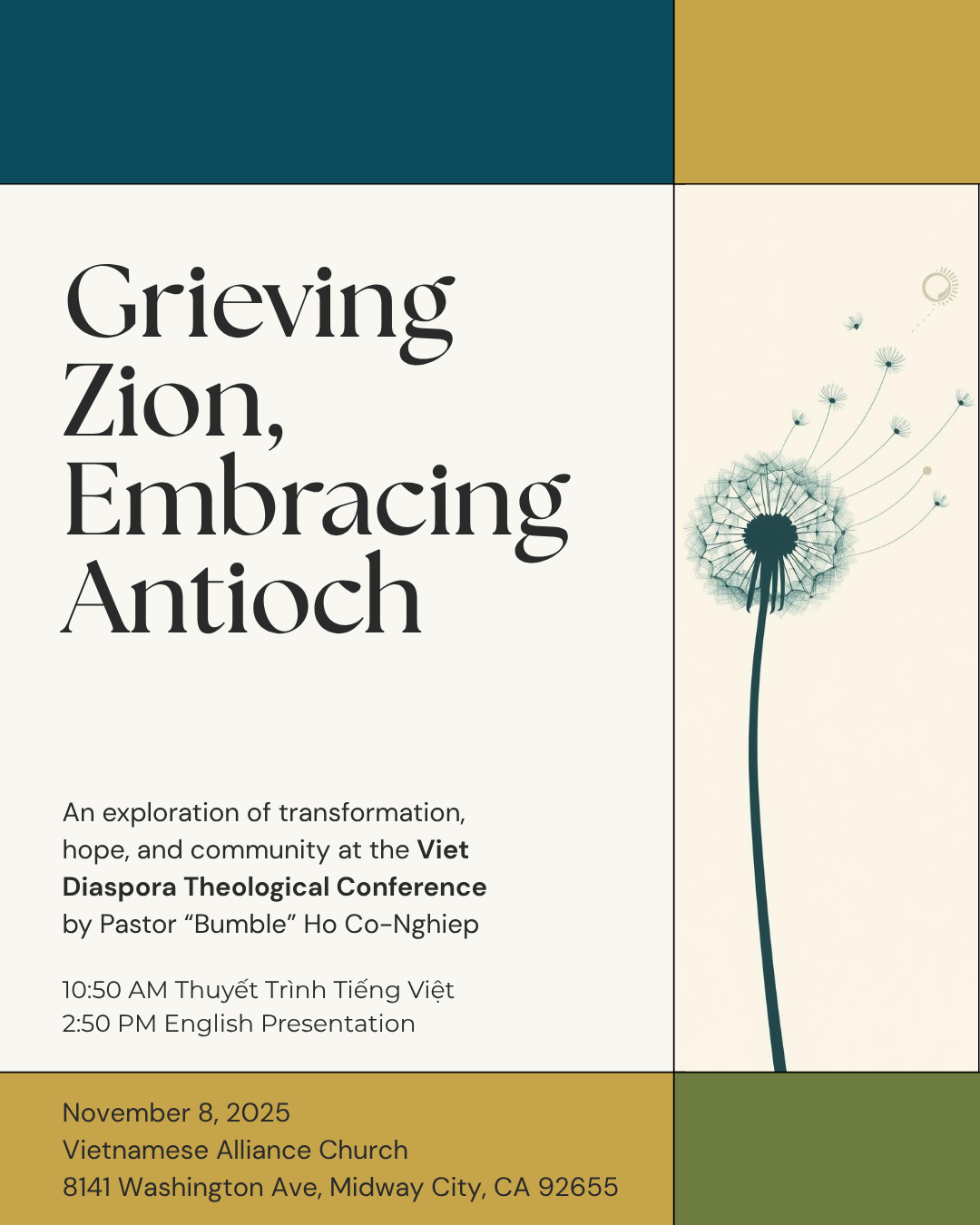
Rethinking Diaspora through Romans 9–11
Co Nghiep Ho, Redemption Point Church
Paper presented at the First Vietnamese Diaspora Theological Conference (read this in Vietnamese, or download the PDF)
Midway City, California, November 8, 2025
Abstract
The Jubilee 50th anniversary of the Vietnamese Christian diaspora invites a reexamination of the theological frameworks that have shaped its self-understanding. The dominant paradigm of “Exile and Exodus,” while essential in narrating survival and providence, risks cultivating an inward-facing identity centered on cultural preservation. This paper proposes a Pauline alternative drawn from Romans 9-11. Paul’s lament for Israel honors the grief of diaspora communities, while his call to righteousness by faith and his vision of the grafted-in branches shift the church’s gaze outward. Through Paul, the Vietnamese church can move from grieving Zion to building Antioch: a sending church that embraces both its ethnic story and its universal calling in Christ.
Introduction: The Jubilee at the Crossroads
The year 2025 marks the 50th anniversary of the Fall of Saigon—a Jubilee that invites the Vietnamese Christian diaspora to pause, remember, and reimagine its future. Fifty years ago, over 125,000 Vietnamese fled their homeland in the chaotic aftermath of April 30, 1975, followed by waves of “boat people” who risked death at sea for freedom.[^1] Christians were disproportionately represented among these refugees: while Catholics comprised only 7% of Vietnam’s population, they constituted roughly 50% of the first wave of refugees.[^2]
Protestants, though a much smaller community than Catholics (roughly 1-2% of Vietnam’s population), also joined this exodus in significant numbers.[^3] Many evangelical pastors, lay leaders, and their families escaped or were evacuated alongside U.S. personnel, anticipating repression. A significant share of the Protestant community either fled in 1975 or left later as ‘boat people.’ Early refugee accounts highlight the active role of Protestant Christians during the flight and in refugee camps. In the U.S. resettlement centers, Protestant worship, evangelism, and practical assistance emerged immediately. One well-documented example comes from Fort Chaffee, Arkansas, where Vietnamese Alliance pastors served as chaplains; over 966 refugees professed faith in Christ within seven months, and 633 were baptized through preaching, Bible classes, and pastoral care.[^4]
Protestant denominations and mission agencies mobilized quickly. The Christian and Missionary Alliance (C&MA) formed a Vietnamese District in 1975 to give refugees an ecclesial home. That district has since grown to over one hundred Vietnamese Alliance churches nationwide.[^5] Southern Baptists likewise urged churches to pray for and aid Vietnamese refugees in 1975. More broadly, faith-based agencies were central to resettlement: religious organizations sponsored and assisted a large share of Southeast Asian refugee families, providing housing, jobs, and community.[^6] Today, Christians make up over one-third of the 3.5 million Vietnamese living in diaspora worldwide.[^7]
This displacement birthed vibrant Vietnamese Christian communities across North America, Europe, and Australia. Churches became not merely worship spaces but community centers—places where refugees rebuilt their lives, preserved their language and culture, and passed their faith to the next generation. Once resettled, Vietnamese Protestants established worshipping communities at a remarkable pace. Churches often began as small Bible studies in apartments and grew into formal congregations in major diaspora hubs. Evangelism in the diaspora led to many new conversions among refugees of Buddhist or nonreligious backgrounds. Within one generation, Vietnamese Christians founded hundreds of churches across North America, Europe, and Australia.
The dominant theological framework that has shaped this community’s self-understanding is what scholars call the “Exile and Exodus” paradigm: viewing 1975 as an exile from the homeland, the refugee journey as an exodus through the wilderness, and the diaspora as a people awaiting restoration.
Yet as the Vietnamese diaspora enters its second half-century, cracks appear in this framework. The first generation—now in their 70s and 80s—clings to refugee identity and dreams of return, while the second generation, born in America, cannot relate to an exile they never experienced. Churches struggle with what many Asian American ministry leaders have termed the “silent exodus”: a widespread phenomenon where second-generation members, who cannot personally relate to the trauma of exile and often feel more at home in English-speaking contexts, quietly drift away from their parents’ church.[^8] The preservation-focused “Exile” paradigm, while vital for the first generation, can inadvertently create cultural and linguistic barriers that make the church feel inhospitable to its own children. The Exile and Exodus paradigm, while essential in narrating survival and providence, risks cultivating an inward-facing identity centered on cultural preservation rather than missional engagement.
The initial theological pivot to an anti-exile mindset owes a significant debt to leaders like Dr. Thach Vinh Le, my mentor since 1998 and later the Vietnamese District Superintendent (2012–2020). Dr. Le recognized that the preservationist “Exile” mindset, with its orientation toward eventual return, was spiritually and missiologically inadequate for a permanent diaspora. He actively promoted reframing Diaspora scattering as a divine opportunity for mission—a shift that created institutional space for churches like Midway and Redemption Point to experiment with the Antioch model.
Other district leaders contributed to this shift. Pastor Tri Minh Dang, wrestling with English-speaking ministry needs at his Anaheim church, publicly championed Antioch as the necessary ecclesiological model for the diaspora’s second generation at Vietnamese Pastor Conferences in the early 2000s.[^9] Outside of our district, earlier conversations in the 1980s among leaders like Dr. Phu Xuan Ho and the late Pastor Do Van Nguyen had already surfaced the long-term challenges of maintaining ethnic identity across generations—challenges that demanded more than preservation-focused strategies. These voices created the theological and institutional conditions for the practical experiments that follow.
This paper proposes a Pauline alternative drawn from Romans 9-11. Paul’s profound wrestling with Israel’s rejection of their Messiah offers striking parallels to the Vietnamese diaspora experience. His “unceasing anguish” (Rom 9:2) honors the grief of displaced communities, while his radical theology of righteousness by faith and his vision of Gentiles grafted into God’s covenant people shift the church’s gaze outward. Through Paul, I argue that the Vietnamese church can move from grieving Zion to building Antioch—from a preservation-focused community longing for an irretrievable past to a sending church that embraces both its ethnic story and its universal calling in Christ.
The journey from theory to practice is not abstract. As pastor of Redemption Point Church, a Vietnamese American church plant launched in 2010 from Midway English Ministry, I have witnessed firsthand both the promises and perils of this paradigm shift. Our story—including a painful church conflict in 2009, a missional re-planting in 2010, and the unexpected arrival of Vietnamese-speaking believers joining our English-language church in 2024—provides concrete evidence that moving from Zion to Antioch is not merely a theological aspiration but a lived reality.
Part I: The Exile and Exodus Paradigm: Strengths & Limitations
How Vietnamese Christians Have Framed Their Story
While formal theological literature specifically articulating an “Exile and Exodus paradigm” for Vietnamese Christians remains limited, these concepts saturate diaspora discourse. Anthropologist Janet Hoskins defines the distinction: exile signifies unwilling rupture, forced displacement, and suffering, while exodus invokes the biblical narrative of mass movement imbued with theological meaning and divine deliverance.[^10] Vietnamese refugees have employed both frameworks to make sense of their trauma.
The paradigm functions on multiple levels. First, it provides a survival and providence narrative. Vietnamese Christians recount miraculous escapes from Communist Vietnam, divine guidance through refugee camps, and God’s provision in resettlement. As one boat person testified, “Many people didn’t make it—they were drowned, they were killed by pirates. I was among the lucky ones.”[^11] The Exodus lens transforms random survival into divine rescue, chaos into covenant faithfulness.
Second, it creates community identity and cohesion. The shared experience of displacement—what the Vietnamese call “tản lạc” (scattering)—forges powerful bonds. Vietnamese Christians don’t identify merely as immigrants who chose to relocate, but as refugees who were forced to flee. This distinction matters. The anti-Communist stance pervasive in the Vietnamese diaspora flows directly from experiences of religious persecution under the Communist regime.[^12]
Third, the paradigm drives cultural and religious preservation. If the diaspora is temporary exile awaiting return or restoration, then maintaining Vietnamese language, liturgy, and tradition becomes paramount. Churches conduct services in Vietnamese, celebrate Tết (Lunar New Year) with traditional foods and customs, and organize youth groups explicitly designed to transmit both faith and culture to the next generation. As the Catholic theologian Peter C. Phan observes, “The church was not simply a place of worship, but it was the center of the Vietnamese community.”[^13]
The Paradigm’s Undeniable Strengths
The Exile and Exodus framework has served the Vietnamese diaspora remarkably well. It provided meaning-making for incomprehensible trauma, transforming senseless loss into a chapter in God’s redemptive story. It fostered hope—the future orientation essential for refugees to rebuild rather than despair. It clarified identity in a disorienting new world, answering the question “Who are we?” with: “We are God’s people in exile.” It created solidarity and mutual support systems that enabled economic advancement and community flourishing. And it demonstrated profound resilience, with Vietnamese Christians not only surviving but establishing hundreds of churches, seminaries, and mission organizations within a single generation.
At the 50th Jubilee, we must honor this legacy. The Exile and Exodus paradigm was not a theological mistake—it was a lifeline.
The Limitations Becoming Visible at 50 Years
Yet as the Vietnamese diaspora matures, the paradigm’s limitations grow apparent. Most fundamentally, it cultivates an inward focus. When the primary task is preservation of language, culture, orthodoxy, and memory, churches naturally become ethnic enclaves. Vietnamese Baptist Church of Quincy lamented in 2024: “Our church lacked young people… we have not been able to reach out to migrants and Vietnamese students because the church lacks young Christians.”[^14] The preservation imperative paradoxically undermines the very future it seeks to protect.
The paradigm also creates temporal stuckness. Fifty years later, many first-generation Vietnamese still identify primarily as refugees—a category their American-born grandchildren cannot inhabit. The Vietnamese diaspora has, in the words of one observer, “become trapped by history.”[^15] Perpetual exile identity prevents full engagement with present opportunities and future possibilities.
The anti-Communist fixation embedded in the exile narrative, while understandable given genuine persecution, can overshadow the gospel itself. Politics could easily become a litmus test for authentic Vietnamese Christian identity. This makes reconciliation with contemporary Vietnam—which has undergone significant economic and social transformation since Đổi Mới (renovation) began in 1986—nearly impossible for many in the diaspora.
Most critically for this paper’s argument, the Exile and Exodus paradigm fosters a limited mission vision. The fundamental posture is defensive: protecting what we have, preserving who we are, waiting for restoration. The Exile narrative, by its very structure, doesn’t naturally generate a sending church. It produces a scattered people longing for home, not a missionary movement proclaiming good news to the nations.
Part II: Paul’s Lament and Liberation: Reading Romans 9–11
The Historical Context: A Church in Transition
To understand Paul’s passionate argument in Romans 9-11, we must grasp both the historical dynamics of the Roman church and Paul’s own conflicted heart. A crucial event had occurred about eight years earlier, around 49 AD: Emperor Claudius expelled the Jews from Rome. The Roman historian Suetonius recorded: “Since the Jews constantly made disturbances at the instigation of Chrestus, he [Claudius] expelled them from Rome” (Iudaeos impulsore Chresto assidue tumultuantis Roma expulit).[^16] “Chrestus” was almost certainly a reference to Christ, suggesting the expulsion was triggered by synagogue conflicts over Jesus’s messiahship.
This expulsion had profound implications for the Roman church, which likely began in Jewish synagogues. For several years, the church became predominantly Gentile-led by necessity. When Claudius died in 54 AD, Jews began returning to Rome—including Jewish Christians like Priscilla and Aquila (Rom. 16:3), whom Paul had met in Corinth after their expulsion (Acts 18:2).
The returning Jewish Christians found a church culture now shaped by Gentiles. Worship practices, leadership structures, and theological emphases had all shifted during their absence. The Gentile Christians, now in the majority and having successfully sustained the church without Jewish leadership, may have felt superior, viewing Jewish rejection of Jesus as evidence that God had permanently replaced Israel with the Gentile church.
But here we must pause and consider Paul himself. He was not writing as a detached theologian offering abstract reflections on salvation history. He was writing as a first-generation Jewish believer watching his people—the people he loved with “unceasing anguish”—being marginalized in the very movement their Messiah had founded.
Paul’s credentials were impeccable. He was “circumcised on the eighth day, of the people of Israel, of the tribe of Benjamin, a Hebrew of Hebrews; as to the law, a Pharisee” (Phil 3:5). He understood Torah, spoke Hebrew and Aramaic, observed Jewish customs. He could trace his lineage. He embodied Jewish identity. And yet, he had become the apostle to the Gentiles—the one tasked with bringing outsiders into God’s family. Imagine the internal tension: deep love for his heritage combined with a calling that seemed to threaten that very heritage’s centrality.
Everywhere Paul went, he saw the same painful pattern. Jews rejected the gospel; Gentiles embraced it. Synagogues expelled him; Gentile households welcomed him. The people most prepared for the Messiah said no; the people with no preparation said yes. And now, in Rome—the capital of the empire, the church will shape Christianity’s future. At the same time, another dynamic was hardening into arrogance. Gentile believers were beginning to think God was done with Israel. The wild olive branches were despising the natural branches.
Paul’s heart was breaking in two directions simultaneously. He grieved that most Jews had rejected Jesus: “I have great sorrow and unceasing anguish in my heart. For I could wish that I myself were accursed and cut off from Christ for the sake of my brothers, my kinsmen according to the flesh” (Rom 9:2-3). But he also feared that Gentile arrogance would corrupt the church’s understanding of God’s faithfulness. If God could simply discard Israel after millennia of covenant relationship, what guarantee did Gentile Christians have of their own security?
Paul’s torn heart—grieving for his people while leading a Gentile movement—is not merely an ancient sentiment; it is the very anguish of the Vietnamese diaspora. First-generation Vietnamese refugees understand Paul’s torn heart. They love their heritage—the language, the culture, the shared history of survival. They want their children to know where they came from, to honor the sacrifices made, to preserve what nearly died in 1975. And yet, they watch their churches become English-dominant. They see their children more comfortable in American culture than Vietnamese. They witness leadership shifting to the second generation, whose experience of “being Vietnamese” is entirely different from their own.
Like Paul, first-generation Vietnamese believers face a painful tension: How do you honor your heritage without making it an idol? How do you grieve what’s being lost without resenting what’s being gained? How do you pass the baton to the next generation when they don’t fully understand what you’re handing them?
Paul’s answer in Romans 9-11 is not to choose between heritage and mission, between preserving Jewish identity and welcoming Gentiles. His answer is to reframe identity itself around Christ the root. Both natural branches (Jews) and wild branches (Gentiles) draw life from the same source. Both stand by faith alone, not by ethnicity or effort. And both must practice humility—Jews remembering that salvation has always been by grace, Gentiles remembering that they are latecomers grafted into Israel’s olive tree, not a new tree of their own making.
Paul writes to correct Gentile arrogance while assuring Jewish believers of their continuing place in God’s plan. He writes as someone who loves Israel deeply while accepting that the gospel is breaking the ethnic boundary. He writes with the authority of a Pharisee and the vulnerability of a father watching his people miss their Messiah. He writes, in other words, from exactly the place where first-generation Vietnamese believers find themselves: torn between grief and hope, heritage and mission, preservation and transformation.
Paul’s Anguish, The Diaspora’s Heart (Romans 9:1-5)
With this context, we can now hear Paul’s opening words with fresh intensity. Paul opens what many scholars consider the theological heart of Romans with startling emotional intensity: “I have great sorrow and unceasing anguish in my heart. For I could wish that I myself were accursed and cut off from Christ for the sake of my brothers, my kinsmen according to the flesh” (Rom 9:2-3). N.T. Wright notes that “it is straightforwardly impossible to read Romans 9-11 as anything other than a statement firmly and deeply grounded in christology”—yet Paul’s christology is inseparable from his pastoral heart.[^17]
This is the anguish of diaspora. Paul writes not as a detached theologian but as a man caught between two worlds: his Jewish heritage and his calling to the Gentiles, his love for Israel and his commitment to a gospel that transcends ethnic boundaries. He lists Israel’s unique privileges with obvious reverence: adoption, glory, covenants, law, temple worship, promises, patriarchs, and most supremely, the Messiah himself “according to the flesh” (Rom 9:4-5). Douglas Moo captures the tension: “Why, then, is Israel not being redeemed, as the Old Testament promised?”[^18] Paul’s grief flows from the tragic irony that the people most prepared for the Messiah have largely rejected him.
As a Vietnamese American pastor, I know this anguish. I recently returned from Vietnam and encountered Christians there making extraordinary sacrifices for the gospel—leaving promising careers to plant churches through sports ministry. But I also discovered the Joshua Project’s assessment: the Kinh people, ethnic Vietnamese, remain “orange” on their scale, meaning the gospel has not yet widely reached them. Out of 98 million people, the vast majority live and die without knowing Christ. Paul models for the Vietnamese diaspora how to hold simultaneously two truths: deep love for one’s people and unflinching commitment to God’s universal gospel.
Beyond Bloodlines: The Scandalous Democratization of Grace (Romans 9:6-10:13)
Paul’s theology in Romans 9-11 systematically dismantles any claim to privileged standing before God based on ethnicity, heritage, or human effort. His argument unfolds in three devastating waves.
First, identity is not in lineage (Rom 9:6-9). “Not all who are descended from Israel belong to Israel, and not all are children of Abraham because they are his offspring” (9:6-7). The examples of Isaac over Ishmael and Jacob over Esau prove that physical descent from Abraham guarantees nothing.
Second, identity is not in effort (Rom 9:10-18). Jacob was chosen over Esau before either “had done anything good or bad, in order that God’s purpose of election might stand—not because of works but because of him who calls” (9:11). Paul’s quotation of Exodus 33:19—”I will have mercy on whom I have mercy, and I will have compassion on whom I have compassion” (9:15)—establishes mercy as God’s sovereign prerogative.
Third, identity is found only in God’s mercy (Rom 9:24-33). And this mercy extends shockingly beyond Israel to the Gentiles. Paul strings together Old Testament prophecies like pearls on a necklace: Hosea’s promise that “Not my people” will be called “sons of the living God” (9:25-26), and Isaiah’s remnant theology showing that only a small number will be saved (9:27-29).
Romans 10 intensifies this trajectory. Christ is “the end of the law for righteousness to everyone who believes” (10:4)—not its fulfillment as a goal but its termination as a system. The conclusion could not be more universal: “Everyone who calls on the name of the Lord will be saved” (Rom 10:13, quoting Joel 2:32). As I explained to my congregation, “The difference between ‘religion’ and the Gospel is this: ‘Religion’ asks, ‘What do I need to do to be acceptable to God?’ The Gospel asks, ‘What has Christ already done to make me acceptable to God?'”[^19]
Grafted Branches and the Christological Olive Tree (Romans 11:1-24)
The olive tree metaphor of Romans 11:17-24 has generated extensive scholarly debate, but Svetlana Khobnya’s christological reading proves most compelling and transformative for diaspora theology. The root is Christ himself, not merely the patriarchs or ethnic Israel.[^20]
Khobnya’s evidence is substantial. First, Paul explicitly identifies Christ as “the root of Jesse” in Romans 15:12, citing Isaiah 11:10. Second, Christ is described as ἀπαρχή (first fruits) in relation to resurrection (1 Cor 15:20-23), paralleling the “first fruits” language in Romans 11:16. Third, Christ is πρωτότοκος (firstborn Son), the beginning of God’s renewed family (Rom 8:29).
This reading transforms the entire metaphor:
- The cultivated olive tree = the people of God defined by relationship to Christ
- The root = Christ, the source of all life and holiness
- Natural branches = ethnic Jews with historical connection to God’s promises
- Wild olive branches = Gentiles with no prior claim
- Grafted in = Gentiles brought by grace into participation in Christ
Paul notes the agricultural absurdity: normally cultivated branches are grafted onto wild rootstock, but here wild branches are grafted into a cultivated tree (11:24). The reversal is deliberate: Gentiles had nothing to offer. They contribute no superior genetics, no accumulated merit, no religious pedigree. They come as wild branches sustained entirely by the root’s richness—that is, by Christ.
This carries profound implications for the Vietnamese church. We are wild olive branches. Vietnamese and Americans are the same; we came to Christ not through the line of Abraham, not through Mosaic covenant, not through temple and priesthood. We came as outsiders, recipients of shocking grace, grafted in by faith alone. Our identity is not rooted in being Vietnamese but in being united to Christ. As I argued in my critique of Vietnamese culturalism, “Your identity in Christ is not a Vietnamese Christianity, but a Vietnamese expression of the Gospel of Jesus Christ. The tree is not ours to shape. We are invited to dwell in it. Culture becomes the context, not the content, of discipleship.”[^21]
Part III: From Zion to Antioch: An Ecclesiological Paradigm Shift
Why Not Jerusalem?
If the Exile and Exodus paradigm naturally produces a Jerusalem model—a people gathered around temple and tradition, focused on purity and preservation—then Romans 9-11 points toward something different. Jerusalem was the mother church, the historical center of Judaism and early Christianity. But it was Antioch that became the missionary engine of the early church.
The contrast matters. While the Jerusalem church, led by James and the apostles, was initially cautious about full Gentile inclusion, its role was also supportive. When persecution scattered believers, the initial missionary impulse came from believers from Cyprus and Cyrene who began “speaking to the Hellenists also” (Acts 11:20). In response, as Pastor Hung Pham observes, the Jerusalem church intentionally sent Barnabas—a trusted bridge-builder—to verify and encourage this new work (Acts 11:22).[^21a] This reciprocal relationship is key: Jerusalem looked backward to its heritage, but also sent leaders to bless the future; Antioch looked outward to the nations, but also sent relief back to the mother church. Jerusalem preserved tradition; Antioch pioneered mission.
The Church That First Called Them Christians (Acts 11:19-30)
In my framework “Versioning the Church,” I identified Antioch as the Biblically paradigmatic v3.0 church—a mature, missional community that had moved beyond both the intimate huddle phase (v0.5) and the institutional organizing phase (v2.0) to become a genuine sending center.[^22] Four characteristics marked Antioch as missional:
- Remarkable Outreach to Unbelievers: The church was birthed through evangelism to both Jews and Gentiles. “The hand of the Lord was with them” (11:21), indicating divine approval of their boundary-crossing witness.
- Spirit-Led Generosity and Mercy: Antioch demonstrated remarkable responsiveness to God’s leading and to human need. When the Spirit revealed through Agabus that famine was coming (11:28), the church responded immediately with sacrificial giving, sending relief to Jerusalem (11:29-30). Despite being a young, multiethnic church with limited resources, they practiced grace-motivated generosity, not legalistic obligation. The pattern matters more than the mechanism: God revealed a need, and the church responded with costly compassion.
- Sustained Teaching Ministry: Barnabas and Saul “taught a great many people” for a full year (11:26). This wasn’t seeker-sensitive entertainment but sustained biblical instruction that formed mature disciples capable of being sent.
- Worship-Centered Mission Sending: Acts 13:1-3 describes the pivotal moment: “While they were worshiping the Lord and fasting, the Holy Spirit said, ‘Set apart for me Barnabas and Saul for the work to which I have called them.'” Commissioning happened not in a committee meeting but in the context of prayer, fasting, and worship. Mission emerged from communion with God.
Antioch as Theological Embodiment of Romans 11
The connection between Paul’s olive tree theology and Antioch’s ecclesiology should now be obvious. Antioch was the grafted tree made visible: natural branches (Jewish believers like Barnabas and Paul) and wild branches (Gentile converts) drawing life from the same root (Christ), worshiping together, and being sent out together.
Antioch demonstrated that the gospel creates “one new man” (Eph 2:15). The dividing wall of hostility between Jew and Gentile had been destroyed in Christ. Cultural distinctions remained—Paul was still identifiably Jewish, Lucius still North African—but these became expressions of the gospel rather than definitions of it. Christ doesn’t merely preserve ethnic distinctions—He creates something entirely new.
Part IV: Practical Implications for Vietnamese Diaspora Churches
1. Reframe Identity from Ethnic Preservation to Gospel Participation
Churches must help Vietnamese Christians—especially the second generation—answer the question “Who am I?” with a Pauline answer: “I am a wild olive branch, grafted by grace into God’s family, sustained by Christ the root.” This doesn’t erase Vietnamese identity; it subordinates it to a more fundamental identity.
Practically, this means worship services that celebrate Vietnamese culture as a gift to offer the global church rather than a fortress to defend. Sermons should regularly emphasize texts like Revelation 7:9—”a great multitude from every nation, tribe, people and language”—alongside Romans 11. Youth groups should equip young people not just to speak Vietnamese but to speak gospel fluency in multiple cultural contexts.
2. Develop Bilingual and Bicultural Leadership Through English Ministries
The most urgent challenge facing Vietnamese diaspora churches is the generational leadership gap. First-generation pastors are aging; second-generation young adults have largely left. The solution is not choosing between Vietnamese-speaking or English-speaking ministry but raising up leaders who are fluently bilingual and theologically grounded in both contexts.
Antioch had this: Paul navigated both Jewish and Hellenistic worlds; Barnabas bridged Cypriot and Jerusalem cultures. Vietnamese churches need leaders who can preach in Vietnamese to grandmothers, counsel in English with millennials, and explain Vietnamese cultural values to multiethnic church plants.
This dynamic also reveals a crucial lesson about leadership succession. As Pastor Hung Pham astutely observes, different stages of a movement require different leadership gifts. The initial phase required a peacemaker and bridge-builder like Barnabas to validate and connect the new work with the established Jerusalem leadership. Subsequently, as the mission expanded and required a robust theological framework, the apostle Paul’s gifts brought him to the forefront. This suggests a need for wisdom in recognizing and empowering the right leaders for the right season, honoring the foundational work of the ‘Barnabases’ while making way for the apostolic drive of the ‘Pauls.’
By the 1990s-2000s, Vietnamese diaspora churches faced a shared challenge: serving the second generation, who grew up in Western cultures and spoke primarily English. Many congregations responded by forming an English Ministry (EM) to bridge generations under one church. Without such efforts, youth often drifted to mainstream churches or left church life altogether—a pattern documented across Vietnamese diaspora communities.[^23]
One effective approach is the ‘One Church, Two Languages’ model, where Vietnamese- and English-language congregations share one leadership family while ministering in their primary languages. A Texas case study, Redeemer Baptist Church of Plano, merged two Vietnamese churches and now begins worship together before moving to simultaneous Vietnamese and English sermons, reuniting afterward as one body.[^24] This model embodies the Antioch vision of unity in diversity.
In Australia, Earthen Vessels Church (Melbourne) has been bilingual since 1981 and intentionally unites generations around a shared mission. Older and younger members partnered for mission teams to Vietnam, with elders supporting and youth leading on-the-ground service—a concrete way to bridge language and culture through a common cause.[^25]
Some second-generation English ministries increasingly adopt a multiethnic focus while remaining connected to their Vietnamese church. A South Australian example explicitly envisions the English-speaking second generation transitioning toward a multi-ethnic community as an expression of gospel hospitality.[^26] This represents a tangible step from preservation (Zion) toward mission (Antioch).
Several best practices recur across these examples:
- Deliberate language inclusion (translation, bilingual services, and culturally-aware celebrations)
- Intergenerational mentorship and shared mission
- Investment in bilingual leadership development (including internships and scholarships for second-generation leaders)
- Cross-church networking for peer learning and youth critical mass
Leaders across Vietnamese denominations emphasize the urgent need to raise second-generation pastors and lay leaders. As one Vietnamese Baptist leader put it: “Pray for the second generation… Not many young [Vietnamese] people are going into ministry, even for English ministry.”[^27]
Where these practices are implemented, outcomes are hopeful: English Ministries grow, second-generation leaders emerge, and churches become bridges to their multiethnic neighborhoods. Conversely, where engagement lags, aging congregations face decline. The English Ministry is not merely a parallel service, but a crucial incubator for the next generation of leadership and the first frontier for the church’s missional engagement.
3. Case Study: Midway English Ministry and Redemption Point Church—From Preservation to Antioch
The journey from theory to practice requires both theological conviction and organizational courage. The story of Midway English Ministry and its successor, Redemption Point Church, provides a concrete case study of a Vietnamese diaspora church attempting to live out the paradigm shift from preservation-focused Zion to mission-sending Antioch.
The Theological Pivot: From Maintenance to Mission (1996-2008)
Midway English Ministry began as a typical youth group in the 1990s within a Vietnamese immigrant church. But a critical moment came with the launch of the English college ministry when the youth leader and later founding pastor of Redemption Point articulated a conviction that would shape the next three decades: “If God won’t use us to reach new people, then it’s better just to close up shop. What’s the point of having just another ministry?”[^28] This represented a fundamental theological reorientation: the central question became, “How do we mobilize the next generation for God’s mission?” rather than “How do we preserve Vietnamese Christian identity?” The first question produces a maintenance-focused ethnic enclave; the second produces a missionary church.
By 2001, leadership explicitly recognized that the English-speaking youth could not be treated as perpetual children of the mother church. They were a mission field to be reached and empowered, not merely Vietnamese-language church members who happened to speak English.[^29] This required cultivating a congregation that was self-supporting, self-governing, self-propagating, and self-theologizing—the classic marks of a mature missionary church rather than a dependent satellite.[^30]
The paradigm contrast became explicit in planning documents:
- From Preservation → To Participation in God’s mission
- From Monoculture → To Multi-ethnic, bilingual teams
- From Pain turned inward → To Proclamation turned outward
- From Custodial leadership → To Sending leadership[^31]
Practically, this meant accepting that cultural identity alone would no longer gather people. The church must become missionary in its local context—engaging lost people regardless of background, introducing them to the Gospel, and discipling them.[^32]
By 2008, Midway’s English service averaged over one hundred in attendance, including many with no family ties to the Vietnamese church.[^33] The EM had become an entry point for the broader community, not merely a linguistic accommodation for immigrant children.
Navigating Intergenerational Tensions: The 2009 Crisis and 2010 Church Plant
The transition from preservation to mission, however, is rarely smooth. Midway’s journey illustrates the profound challenges of intergenerational ministry in diaspora contexts.
Leadership navigated how much independence to grant the English congregation, an issue that had been formalized in the district’s conversations. Dr. Thach Vinh Le had presented the structural options—the Umbrella model (EM remains a department of the mother church), the Parallel model (a semi-autonomous congregation), and the fully Congregational model (an independent church plant)—at the 2003 District Conference.[^34] This district-level attention to EM structural options signaled growing recognition that the English-speaking second generation required more than linguistic accommodation—they needed ecclesial autonomy to pursue their missional calling. By 2005-2008, the trend was toward parallel development: an English Leadership Team formed, a part-time college pastor was hired for EM, and the EM was granted its own budget and bank account.[^35]
Then came 2009. A major conflict split the Vietnamese-language church, and the new board repealed the parallel model decision—pulling the English ministry back to the Umbrella model at the start of 2010. Attendance and morale suffered.[^36] The preservation instinct, triggered by crisis, reasserted itself.
By 2010, recognizing the unified model was failing, 40 people from the English congregation launched as Redemption Point Church with the blessing of the Vietnamese District—framed not as a hostile split but a “re-planting” for mission.[^37] The language is significant: not abandonment but strategic multiplication. Redemption Point chose to colocate with the splintered Vietnamese-language group formed a congregation a year before. The two congregations would coexist on the same campus with separate services and separate leadership, yet in a spirit of partnership—a “two bodies, one house” approach.[^38]
Internal “Guidelines to Harmony” document, authored by Dr. Robert Goette, a consultant on EM development, encouraged flex management: the first generation should accommodate the values and norms of the second generation as long as they are biblical. Language carries culture; forcing Vietnamese in the EM would place an unnecessary cultural yoke on them.[^39] English-speaking members were encouraged to evangelize beyond the Vietnamese community; not to evangelize is to be sterile, and not to allow them leadership is to deny the use of their spiritual gifts.[^40]
Redemption Point’s annual reports articulated a clear missional vision: to see the redeeming relationship of Jesus awaken in ourselves, then in our circles, replicating the Gospel to the fourth generation and beyond.[^41] The mission statement in its Church Planting proposal crystallized the Antioch conviction: “Be captivated by God’s love, grow together by His Spirit, and serve and share the Gospel—because the Gospel changes everything.”[^42]
Redemption Point also defined strength differently: not by crowd size but by lives transformed by Jesus. Leaders prayed that at least 10% of attendees would be non-Christians at any given time, to ensure the community remained outward-facing.[^43]
Practical Tools and Frameworks for Becoming Antioch
Moving from preservation to mission required more than theological conviction; it demanded practical tools and frameworks. Both Midway EM and Redemption Point experimented with various discipleship and missional systems.
In the late 1990s, Midway EM adopted SonLife’s disciple-making philosophy, emphasizing intentional multiplication rather than program maintenance.[^44] By 2008, leaders sketched a member spiritual growth map to clarify pathways from seeker to sent-out missionary.[^45]
After the 2010 church plant using the NYC Redeemer’s Church Planting Manual, Redemption Point incorporated tools like the 3DM’s Learning Circle and its Up-In-Out triangle (balancing relationship with God, community, and mission) to regain missional momentum.[^46] Core values development was used for teaching and embedding an outward focus in congregational life.[^47] Each tool was adopted not merely as methodology but as implementation of the Antioch conviction: spiritual formation must be oriented toward mission, not maintenance. This led to seasons of notable fruit, including multiple baptisms.[^48]
Significantly, leaders recognized prayer as the foundation: “Prayer is the real work; evangelism is the following up.”[^49] This conviction should guide our worship gatherings, where mission sending emerged from prayer rather than strategic planning committees—mirroring Antioch’s pattern in Acts 13:1-3.
Outcomes: Mission Engagement and Leadership Development
The shift from preservation to mission bore tangible fruit, particularly in mission engagement and leadership development.
Short-term missions became a catalyst for spiritual formation and vocational clarity. A 2007 mission report documented that for multiple young adults, active participation in God’s global mission led directly to a clearer sense of personal identity, a deep commitment to biblical study, and a vocational focus on long-term ministry. These stories illustrate how missional engagement shapes identity: young adults who could not relate to the exile narrative of their parents discovered their own story through participating in God’s global mission. [^50-53]
By 2010, Midway EM had raised leaders sufficient to sustain two viable congregations: the remaining Midway EM, and the new church plant Redemption Point.[^54] Redemption Point pushed leadership development further: adding staff, launching scholarships, internships, and a church-planting residency to cultivate future pastors and leaders.[^55]
The church also intentionally engaged international students from Japan, Vietnam, and elsewhere. Members shared life, simplified studies into plain English, provided hospitality and rides—living out 1 Thessalonians 2:8 in a multiethnic Antioch identity.[^56]
However, the cost of bicultural ministry is real. In 2012, dual pastoring led to a severe breakdown, prompting a shift to call an additional pastor and a renewed emphasis on lay training and coaching.[^57] This crisis reinforced the need for sustainable models that distribute ministry rather than concentrate it in a few bilingual leaders.
The 2024 Inversion: Vietnamese-Speaking Believers Join an English Church
Perhaps the most striking evidence of the Antioch paradigm’s transformative power came in 2024. A group of Vietnamese-speaking believers—older adults and recent immigrants—approached Redemption Point seeking a church home. Rather than spinning them off to a separate Vietnamese congregation or redirecting them to a Vietnamese-language church, RP invited them into its existing mission, vision, and core values.[^58]
This was a remarkable inversion of the typical pattern. Usually, English-speaking second-generation members join Vietnamese churches and then struggle to find their place. Here, Vietnamese-speaking first-generation believers were joining an English-language church that had been explicitly designed for American-born Vietnamese and their multiethnic neighbors.
RP integrated these believers through its membership process, emphasizing shared commitment to gospel mission over linguistic comfort.[^59] The church also offered a monthly Vietnamese fellowship (RPV) as outreach, which drew dozens and led to new faith professions, before adopting Austin Stone’s Missional Community model to launch a second service for them—accommodating language needs evangelistically without changing RP’s core English identity.[^60]
This model demonstrates the Antioch vision in practice: natural branches (Vietnamese-speaking believers) and wild branches (American-born Vietnamese, international students, and non-Vietnamese members) drawing life from the same root (Christ), worshiping together despite linguistic differences, united by a common mission.
Throughout these transitions, leaders emphasized “grafted-in humility” (Romans 11): stand by faith, do not be proud; prune pride, build bridges.[^61] This theological posture enabled practical flexibility and missional creativity.
Lessons for the Broader Vietnamese Diaspora
The Midway EM and Redemption Point story offers several transferable lessons for Vietnamese diaspora churches:
- Theological clarity precedes organizational change. The shift from preservation to mission required articulating a biblical vision before restructuring programs.
- Intergenerational conflict is inevitable, but can be redeemed. The 2009 crisis nearly destroyed the English ministry, but the re-planting framework transformed conflict into multiplication.
- Practical tools matter. Abstract missional language must be embodied in concrete frameworks, calendars, and practices.
- Leadership development is non-negotiable. Without raising second-generation leaders, English ministries remain dependent appendages rather than sending churches.
- The Antioch model is flexible. The 2024 Vietnamese-speaking group joining an English church demonstrates that mission focus, not linguistic uniformity, defines identity.
- Costs are real but worthwhile. Pastoral burnout, conflict, and the loss of some members are painful realities. But the alternative—a preservation-focused church that loses its children and its mission—is ultimately more costly.
4. Cultivate Spirit-Led Responsiveness and Sacrificial Generosity
Antioch modeled a church attuned to both divine leading and human need. The Spirit revealed a coming famine, and the church responded immediately with mercy ministry, sending relief to Jerusalem (Acts 11:27-30). Later, during worship and fasting, the Spirit called Barnabas and Saul to mission, and the church sent them (Acts 13:1-3).
Vietnamese churches should cultivate this same posture: listening expectantly for God’s direction and responding obediently with both compassion and courage. This looks less like strategic planning committees and more like extended prayer and fasting, asking: “Where is God already at work? What needs has he revealed to us? Whom is he calling us to send?”
The mechanism of divine guidance matters less than the disposition: Are we listening? Are we responsive? Are we generous? God may reveal needs and opportunities through Scripture meditation, pastoral wisdom, providential circumstances, missionary speakers, or—yes—prophetic insight. The Reformed tradition affirms that the Spirit continues to guide the church, even if we’re cautious about contemporary prophecy. What matters is that we’re paying attention and willing to act sacrificially.
Practical opportunities for responsive generosity:
- Support persecuted Christians in Vietnam: Funding house church networks, underground seminaries, and pastors under government pressure
- Fund Vietnamese church plants in under-reached diaspora communities
- Sponsor refugees from other nations: Paying forward the hospitality Vietnamese received in 1975
- Engage Vietnamese international students in North American universities with radical hospitality
- Serve recent Vietnamese immigrants fleeing economic hardship
- Partner with ministries in Vietnam itself, where Christianity is growing rapidly despite government restrictions[^62]
- Build bridges to Southeast Asian diaspora communities with whom Vietnamese Christians share cultural affinity
- Minister to the marginalized in multicultural neighborhoods where Vietnamese churches are located
Antioch sent relief to Jerusalem despite being younger, smaller, and more resource-constrained. Vietnamese diaspora churches should resist the temptation to hoard resources for internal preservation and instead practice Antioch’s pattern: responsive listening, sacrificial giving, and courageous sending.
5. Navigate Denominational Tensions with Kingdom-Mindedness
The temptation toward ethnic pride can manifest at the denominational level. In 2022, an attempt to form a breakaway Vietnamese denomination “by the Vietnamese, for the Vietnamese” emerged within the Vietnamese district. Redemption Point’s leadership chose unity over ethnic pride, focusing on advancing the gospel rather than cultural autonomy.[^63]
This decision embodied Paul’s warning in Romans 11:20: “Do not be arrogant, but be afraid.” Vietnamese Christians, as wild olive branches grafted in by grace, have no grounds for boasting. Our calling is to participate humbly in God’s mission, not to create ethnic empires.
6. Tell a New Story at the 50th Jubilee
The 50th anniversary provides a kairos moment to reframe the Vietnamese diaspora narrative. Instead of the old story—”We are exiles grieving Zion, preserving our heritage until return”—tell a new story: “We are scattered seeds planted by God’s hand, called to bloom where we’re planted and scatter more seeds for his kingdom.”
This new story honors the grief (Paul’s unceasing anguish for Israel) without getting stuck in it. The end of lamentation is mission.
Conclusion: The Doxology the Diaspora Needs
Paul ends Romans 11 not with a strategic plan but with a doxology: “Oh, the depth of the riches and wisdom and knowledge of God!… From him and through him and to him are all things. To him be glory forever. Amen” (11:33, 36). Before the Vietnamese church can do anything for God, it must be silenced by who God is.
The mistake of both the Exile paradigm and the temptation toward cultural preservation is thinking we can secure our future through our efforts—whether by preserving tradition or by strategic planning. Paul’s entire argument in Romans 9-11 demolishes that confidence. We are wild olive branches. We contribute nothing. Christ, the root sustains us. Our standing depends entirely on faith in his finished work, not on our heritage, our cultural authenticity, or our religious performance.
This is not a counsel of passivity. It is liberation for mission. When identity and security rest in Christ alone, the church is free to risk everything for the gospel. Vietnamese Christians don’t need to cling desperately to language and culture because our identity isn’t at stake—Christ has secured it. We can send our best young leaders to the nations because our future doesn’t depend on numerical growth—Christ guarantees it. We can embrace multiethnic worship and cross-cultural relationships because our heritage doesn’t define us—Christ does.
The story of Midway English Ministry and Redemption Point demonstrates that this is not a mere theory. Through conflict and church planting, through mission engagement and unexpected inversions (Vietnamese-speaking believers joining an English church), a missional conviction bore fruit: a multiethnic, intergenerational, mission-sending community that honors its Vietnamese heritage while refusing to be limited by it.
Fifty years after the Fall of Saigon, the Vietnamese diaspora stands at a threshold. Behind us lies the story of survival, providence, and preservation—a story worth honoring. Before us lies an invitation into something more: to be grafted not into the American society but into God’s global mission, to move from grieving what was lost to giving what we’ve received, to stop clinging to Zion and start building Antioch.
The mystery has been revealed: Mercy-Has-Been-Extended! (Rom 11:25-32). Now only one question remains: Will the Vietnamese church join the doxology? Will we worship the God whose wisdom grafted wild branches into his family, and will we become the multiethnic, Spirit-sent, Christ-exalting, mission-saturated church that he is calling us to be?
The Jubilee awaits our answer.

Notes
[^1]: Nathalie Huynh Chau Nguyen, “Vietnamese Diasporas: An Introduction,” in Routledge Handbook of the Vietnamese Diaspora, ed. Nathalie Huynh Chau Nguyen (London: Routledge, 2024), 1-26.
[^2]: Carleton College, ReligionsMN, “The Development of Vietnamese Communities in the US” (noting ~50% Catholic among the first 125,000 refugees in 1975, vs. ~7-10% in Vietnam).
[^3]: Wikipedia, “Christianity in Vietnam” (approx. 1-2% Protestant share in recent estimates).
[^4]: Inheritance Magazine (2017), “Building Bridges for the Vietnamese Diaspora” (story of Pastor ‘Tai’ Nguyen’s chaplaincy at Fort Chaffee: 966 decisions, 633 baptisms).
[^5]: Nghia D. Nguyen, DMin Thesis, Candler School of Theology (2021), and ECFA profile of the Vietnamese District, Christian and Missionary Alliance (Vietnamese District formed June 29, 1975; now 100+ churches).
[^6]: Southern Baptist Convention, 1975 Resolution on Vietnamese refugees; Melissa Borja, “Don’t Turn Refugees Away,” Anxious Bench (Patheos), Aug. 2021 (role of faith-based agencies in resettlement).
[^7]: Philip Jenkins, “The Vietnamese Diaspora,” The Christian Century, January 23, 2013 (diaspora size ~3.5 million; Christian share substantially higher than in Vietnam).
[^8]: Helen Lee, “The Silent Exodus,” Christianity Today, August 1996; see also Peter Cha and Greg Jao, Following Jesus Without Dishonoring Your Parents (Downers Grove: IVP, 1998) for broader discussion of second-generation Asian American Christian experiences.
[^9]: Tri Minh Dang, a sermon presented at the Vietnamese Pastor Conference in early 2000s when he was wrestling with the needs of the English-speaking needs at Anaheim church.
[^10]: Janet Hoskins, “Diaspora as Religious Experience: The Vietnamese in the United States,” Journal of Vietnamese Studies 2, no. 3 (2007): 129-162.
[^11]: Oral history interview, Vietnamese American Heritage Foundation Archives, quoted in Anh Do and Hieu Duc, The Vietnamese Americans (Westport, CT: Greenwood Press, 2006), 78.
[^12]: See Thien-Huong T. Ninh, Race, Gender, and Religion in the Vietnamese Diaspora: The New Chosen People (New York: Palgrave Macmillan, 2017).
[^13]: Peter C. Phan, “Vietnamese Catholics in the United States: Christian Identity between the Old and the New,” U.S. Catholic Historian 18, no. 1 (2000): 19-35.
[^14]: Baptist Convention of New England, “Vietnamese Church Makes History While Struggling to Reach Second Generation,” BCNE News, July 10, 2024.
[^15]: Tino Dinh, “50 Years of the Vietnamese Diaspora: A Reflection,” Medium, April 30, 2025.
[^16]: Suetonius, Life of Claudius 25.4. For discussion of the Claudian expulsion and its impact on the Roman church, see Mark Nanos, The Mystery of Romans (Minneapolis: Fortress, 1996), 372-387; and James D.G. Dunn, Romans 1-8, Word Biblical Commentary (Dallas: Word, 1988), xliii-xlviii. The spelling “Chrestus” (a common name) instead of “Christus” likely reflects Roman confusion about Jewish sectarian disputes. See also the discussion in the Biola University Good Book Blog, “Something About the Book of Romans That Will Help You Really Get It,” https://www.biola.edu/blogs/good-book-blog/2012/something-about-the-book-of-romans-that-will-help-you-really-get-it (accessed November 2025).
[^17]: N.T. Wright, Paul and the Faithfulness of God (Minneapolis: Fortress Press, 2013), 1156.
[^18]: Douglas J. Moo, The Epistle to the Romans, NICNT (Grand Rapids: Eerdmans, 1996), 548.
[^19]: Co Nghiep Ho, “Beyond Bloodlines and Borders: Built by Calling on His Name” (sermon, Redemption Point Church, August 2025).
[^20]: Svetlana Khobnya, “The Root in Paul’s Olive Tree Metaphor (Romans 11:16-24),” Tyndale Bulletin 64, no. 2 (2013): 257-273.
[^21]: Co Nghiep Ho, “Life in God’s Covenant Community: Theological Reflections on Romans 9-11” (unpublished manuscript, 2025).
[^21a]: Hung Pham, “The Jerusalem church intentionally sent Barnabas, a bridge builder, to Antioch to first verify the new movement of the Gospel and then bring Paul to help establish the church there. Not only did the Antioch church support the Jerusalem church. The Jerusalem church was supportive of them as well. So much to learn from that church model for our time. Maybe one of our priorities should be identifying and empowering peace makers, or bridge builders, like Barnabas, for the next generation. Or maybe another lesson will be recognizing that a different kind of leadership is needed for each movement. Soon the name Barnabas faded away, to be replaced by Paul with a stronger theological education and missional conviction.” (Nov. 2025)
[^22]: Co Nghiep Ho, “Versioning the Church: A Framework for Understanding Ecclesial Development” (unpublished paper shared with pastoral colleagues, June 2025).
[^23]: Baptist Churches of New England (BCNE) News, July 10, 2024, “Vietnamese Church Makes History While Struggling to Reach Second Generation.”
[^24]: Texas Baptists (BGCT), June 2, 2022, “Vietnamese Baptists come together as ‘One’ for the gospel” (Redeemer Baptist Church of Plano bilingual model; second-generation concerns).
[^25]: Baptist Union of Victoria (Australia), July 5, 2021, “New Faith Community – Earthen Vessels” (bilingual church uniting generations in mission).
[^26]: Thrive Ministries (Adelaide, Australia), “Our Story” page (EM transitioning toward a multi-ethnic community while rooted in a Vietnamese Evangelical church).
[^27]: Texas Baptists (BGCT), June 2, 2022, “Vietnamese Baptists come together as ‘One’ for the gospel” (quote on the need for second-generation leaders and English ministry).
[^28]: Pastor Co Nghiep “Bumble” Ho, Prayer Newsletters and launch communications (2010).
[^29]: Midway EM Annual Report and leadership notes (circa 2001), Dropbox archive.
[^30]: Redemption Point Church Plant Proposal and strategy notes (2010), Dropbox archive.
[^31]: “Grieving Zion, Embracing Antioch,” paradigm contrast notes (2025), Dropbox archive.
[^32]: Redemption Point leadership reflections on missional posture (2015), Dropbox archive.
[^33]: Midway EM attendance and composition snapshot (2008), Dropbox archive.
[^34]: Midway Church board briefing pack (2000–2007), Dropbox archive.
[^35]: Midway EM board minutes and budget records (2005–2008), Dropbox archive.
[^36]: Midway EM timeline narrative on 2009 conflict, Dropbox archive.
[^37]: Redemption Point Church Plant Proposal (2010), Dropbox archive.
[^38]: Facility-sharing agreements and partnership memos (2010–2012), Dropbox archive.
[^39]: “Guidelines to Harmony”: flex management and cultural accommodation.
[^40]: “Guidelines to Harmony”: leadership and evangelism beyond one ethnicity.
[^41]: Redemption Point mission/vision statements and logo/values documents (2023–2024).
[^42]: Redemption Point mission/vision statements and early documents (2010–), Dropbox archive.
[^43]: Pastor Ho, Prayer Newsletters (2010): measures and evangelistic metrics.
[^44]: Midway EM adoption of SonLife discipleship philosophy (late 1990s).
[^45]: Midway EM member spiritual growth map (circa 2008).
[^46]: RP tools and frameworks: 3DM Learning Circle; Up-In-Out (2014–2015).
[^47]: RP Seven Core Values teaching plan (2023–2024).
[^48]: RP annual summary (2015): baptisms.
[^49]: Prayer Newsletter (2010): prayer as real work; evangelism as follow-up.
[^50]: Midway EM Missions Report (2007): testimony – Vivi.
[^51]: Midway EM Missions Report (2007): testimony – Huy.
[^52]: Midway EM Missions Report (2007): testimony – Christine.
[^53]: Midway EM Missions Report (2007): testimony – David T.
[^54]: Midway EM and RP launch-year summaries (2010), Dropbox archive.
[^55]: RP planning memos and annual report (2015): scholarships, internships, residency; RP Annual Report (2024): leadership additions and intern development.
[^56]: RP Annual Report (2022): international students and hospitality practices; 1 Thess 2:8 application.
[^57]: Midway/VECFV timeline (2012): pastoral health and transition to shared leadership; RP planning memos (2014–2015): Stephen Ministry training; external coaching.
[^58]: Redemption Point Annual Report (2024): integration of Vietnamese-speaking group.
[^59]: Membership process notes for Vietnamese-speaking newcomers (2024), Dropbox archive.
[^60]: Vietnamese fellowship (RPV) monthly outreach report (2024), Dropbox archive.
[^61]: RP Annual Reports (2023–2024): “grafted-in humility,” bridge-building language.
[^62]: According to Operation World, Protestant Christianity in Vietnam has grown over 900% since 1975, despite government restrictions. See Patrick Johnstone and Jason Mandryk, Operation World: 21st Century Edition (Carlisle: Paternoster, 2001).
[^63]: RP Annual Report (2022): district tensions and unity response.
Bibliography
Baptist Churches of New England. “Vietnamese Church Makes History While Struggling to Reach Second Generation.” BCNE News, July 10, 2024.
Baptist Union of Victoria. “New Faith Community – Earthen Vessels.” July 5, 2021.
Borja, Melissa. “Don’t Turn Refugees Away.” Anxious Bench (Patheos), August 2021.
Carleton College. “The Development of Vietnamese Communities in the US.” ReligionsMN.
Cha, Peter, and Greg Jao. Following Jesus Without Dishonoring Your Parents. Downers Grove: IVP, 1998.
Dinh, Tino. “50 Years of the Vietnamese Diaspora: A Reflection.” Medium, April 30, 2025.
Do, Anh, and Hieu Duc. The Vietnamese Americans. Westport, CT: Greenwood Press, 2006.
Ho, Co Nghiep. “Beyond Bloodlines and Borders: Built by Calling on His Name.” Sermon, Redemption Point Church, August 2025.
———. “Life in God’s Covenant Community: Theological Reflections on Romans 9-11.” Unpublished manuscript, 2025.
———. “Versioning the Church: A Framework for Understanding Ecclesial Development.” Unpublished paper, June 2025.
———. Midway English Ministry and Redemption Point Church archives. Prayer newsletters, annual reports, planning documents, mission reports (1996-2024). Dropbox archive.
Hoskins, Janet. “Diaspora as Religious Experience: The Vietnamese in the United States.” Journal of Vietnamese Studies 2, no. 3 (2007): 129-162.
Inheritance Magazine. “Building Bridges for the Vietnamese Diaspora.” 2017.
Jenkins, Philip. “The Vietnamese Diaspora.” The Christian Century, January 23, 2013.
Johnstone, Patrick, and Jason Mandryk. Operation World: 21st Century Edition. Carlisle: Paternoster, 2001.
Khobnya, Svetlana. “The Root in Paul’s Olive Tree Metaphor (Romans 11:16-24).” Tyndale Bulletin 64, no. 2 (2013): 257-273.
Lee, Helen. “The Silent Exodus.” Christianity Today, August 1996.
Moo, Douglas J. The Epistle to the Romans. New International Commentary on the New Testament. Grand Rapids: Eerdmans, 1996.
Nguyen, Nathalie Huynh Chau. “Vietnamese Diasporas: An Introduction.” In Routledge Handbook of the Vietnamese Diaspora, edited by Nathalie Huynh Chau Nguyen, 1-26. London: Routledge, 2024.
Nguyen, Nghia D. DMin Thesis. Candler School of Theology, 2021.
Ninh, Thien-Huong T. Race, Gender, and Religion in the Vietnamese Diaspora: The New Chosen People. New York: Palgrave Macmillan, 2017.
Phan, Peter C. “Vietnamese Catholics in the United States: Christian Identity between the Old and the New.” U.S. Catholic Historian 18, no. 1 (2000): 19-35.
———. Vietnamese-American Catholics. New York: Paulist Press, 2005.
Southern Baptist Convention. “Resolution on Vietnamese Refugees.” 1975.
Texas Baptists. “Vietnamese Baptists come together as ‘One’ for the gospel.” BGCT, June 2, 2022.
Thrive Ministries. “Our Story.” Adelaide, Australia.
Wikipedia. “Christianity in Vietnam.”
Wright, N.T. Paul and the Faithfulness of God. Minneapolis: Fortress Press, 2013.
0 Comments