

Amillennial Perspective (Michael Horton)
In July 2020 (during the pandemic, before ChatGPT), a caller called into a podcast featuring Michael Horton (Reformed author) and asked, “How Do You Feel About Artificial Intelligence Being the Image of the Beast in Revelation 13?”
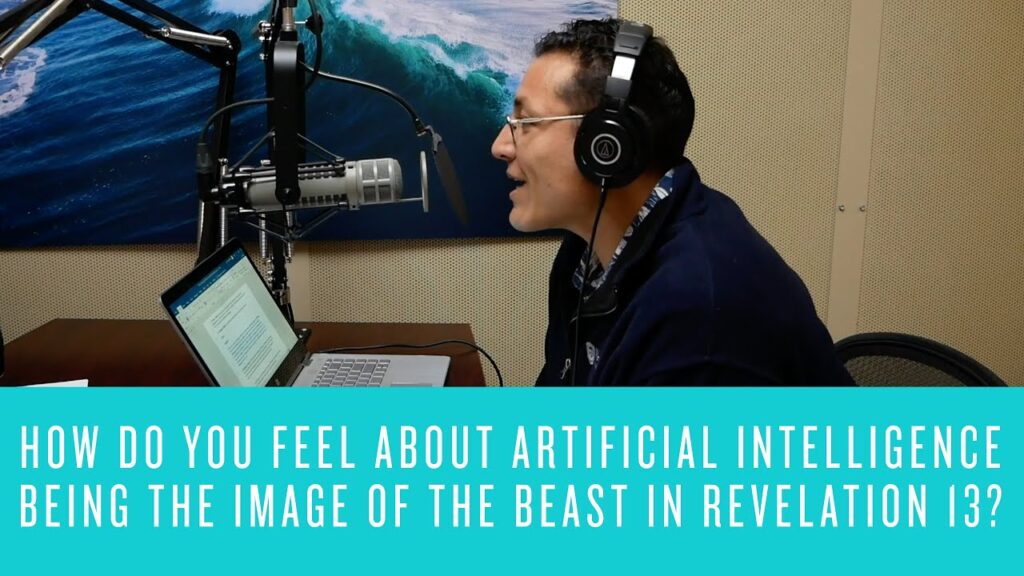
In this short clip, https://youtu.be/lt88F9cbXw8, the hosts of Core Christianity respond to a listener’s question about whether the “image of the beast” in Revelation 13, which is given “breath” to speak [00:11], could be a form of artificial intelligence [00:31]. The host, Adriel Sanchez, says this is unlikely [00:36].
He explains that Revelation was written to persecuted Christians in the first century to encourage them to persevere [00:47]. He argues that the “beasts” in Revelation, much like in the book of Daniel, are symbols for ungodly nations that persecute God’s people [01:01]. The message was primarily to comfort its original audience by showing them that even this terrifying “beast” (representing pagan nations and rulers like Caesar) was “allowed” to do what it does [02:39], meaning God was still in control [03:03]. The imagery fit their reality perfectly, where they were forced to worship the “image of Caesar” or face death [03:46]. While the spirit of antichrist continues today [03:22], the primary interpretation was for them.
Multi-Level Outline
I. The Listener’s Question [00:00]
- A. Scripture: Cites Revelation 13:15, where an “image of the beast” is given life to speak and kill those who don’t worship it [00:03].
- B. The Question: Could this “image” be artificial intelligence (AI)? [00:31]
II. The Host’s Primary Answer [00:36]
- A. Direct Answer: It is unlikely that the image of the beast is AI [00:36].
- B. Context is Key: The Book of Revelation was written to persecuted Christians in the first century [00:44].
- C. Purpose: The book’s goal was to encourage them to persevere in their faith despite trials [00:53].
III. Biblical Interpretation of “The Beast” [00:58]
- A. Symbolic Meaning: In scripture, “beasts” are often symbols for ungodly nations that persecute God’s people [01:01].
- B. Old Testament Parallel (Daniel 7):
- C. The “Spirit of Antichrist”: For 2,000 years, the church has been fighting against the “spirit of the Antichrist,” which was already at work in the first century [02:06].
IV. The Meaning for the First-Century Audience [02:22]
- A. A Message of Comfort: The words were meant to comfort the original audience, not just terrify them [02:27].
- B. God’s Sovereignty: The text says the beast was “allowed” to act [02:39]. This shows that God is still in control, which is a comfort to the suffering [03:03].
- C. Historical Application:
- The host says the “beast” likely referred to the pagan nations (like Rome) that were demanding worship [03:28].
- This “fits perfectly” with the persecutions under emperors like Nero and Diocletian [03:40].
- Christians were forced to “worship the image of Caesar” (e.g., burn incense) or face imprisonment and death [03:49]. For them, this prophecy was a direct reflection of their reality [04:20].
A Christian Scientist Perspective (Dr. John Lenox)
In 2023 (a year after ChatGPT was released), a well-known Oxford professor, Christian mathematician, and author, Dr. John Lenox, shared his view about AI in an interview at https://www.youtube.com/watch?v=X8xooWDd4DM
In this interview, Dr. John Lennox discusses the rise of artificial intelligence from a theological and ethical perspective. He distinguishes between “Narrow AI” (ANI), which performs single tasks, and “General AI” (AGI), the hypothetical, human-level superintelligence [05:05]. Lennox firmly states that current AI shows no signs of true sentience or consciousness, calling it a highly advanced simulation, not genuine thought [08:13].
The main focus of the conversation is on the ethical lag in AI development. Lennox uses the analogy of a knife: it can be used for surgery or murder, and the same applies to AI, which can be used for medical breakthroughs or oppressive government surveillance [11:07]. He connects the dangers of AI surveillance, such as social credit systems [23:28] and “deep fakes” [25:55], to the dystopian visions of Orwell and Huxley [12:06].
Lennox argues that the biblical prophecies in 2 Thessalonians and the Book of Revelation, which describe a final, deceptive world leader who controls the economy and demands worship, are remarkably similar to the secular fears of a globe-spanning, AI-controlled “Omega Corporation” [15:37]. He urges Christians not to dismiss these texts as “lunatic fringe” but to see them as a relevant scenario, warning against a coming global deception [17:08].
Ultimately, he advises against both paranoid retreat and naive embrace. He encourages Christians to “not run away from the technology” [38:52] but to get involved in the field to help shape its ethics [39:17]. His final advice for believers is to protect their human agency by practicing “electronic fasting” [34:41] and to anchor their hope not in resisting technology, but in the ultimate sovereignty of Christ [30:34].
Multi-Level Outline
I. Introduction & Defining AI
- A. Defining Artificial Intelligence:
- 1. Narrow AI (ANI): A system that does one specific task that normally requires human intelligence (e.g., medical diagnosis, GPS) [05:05]. It is a simulation, not real intelligence [05:29].
- 2. General AI (AGI): A hypothetical, human-level intelligence that can do everything a human can. This is the realm of science fiction, and we are nowhere near it [06:23].
- B. The Question of Sentience:
II. The Dangers: Dystopian Futures & Biblical Prophecy
- A. The “Knife” Analogy:
- B. Two Dystopian Scenarios:
- C. The Biblical Scenario (The “Third Dystopia”):
- Lennox argues the biblical worldview must be taken seriously, particularly 2 Thessalonians and Revelation [13:58].
- The Bible predicts a final world leader who will “declare himself to be God” [15:28].
- This prophecy uncannily mirrors secular fears, like Max Tegmark’s “Omega Corporation,” which controls the global economy and forces everyone to have a mark (or “bracelet”) to buy or sell [15:54].
- Lennox connects this to the “mark on their hand or their forehead” in Revelation [16:28].
- D. The Threat of Deception:
III. Human Agency & The Christian Response
- A. The Core of Humanity:
- B. Protecting Human Agency:
- C. The Christian’s Role in an AI World:
- 1. Do Not Retreat: He warns Christians not to “run away from new technology” [38:52]. Running away cedes the ground to “bad actors” [42:44].
- 2. Engage the Ethics: He encourages gifted Christians to go into the field of AI to help build the ethical foundations, which are currently missing a “Transcendent” source [39:17], [41:03].
- 3. Find True Hope: He says the ultimate answer to rising anxiety is not a bunker but a “renewed vision of who is ultimately in control”—the “lamb upon the throne” [30:20], [30:34].
- 4. Focus on Meaning: Science explains how things work, but religion explains what they mean. The church’s role is to inject transcendent meaning back into the culture [46:55].
Spiritual Formation Perspective (John Mark Comer, Andy Crouch)
In Aug. 2025, Andy Crouch (Christian author and former executive editor of Christianity Today) was interviewed on John Mark Comer’s Practicing the Way channel at https://www.youtube.com/watch?v=K2j8053yxbE. The conversation explores the challenges and opportunities AI presents through the lens of Christian spiritual formation, viewing its emergence as a pivotal “2007 moment” (like the iPhone launch) that requires thoughtful pastoral leadership [00:33].
Crouch defines AI as the latest layer in the evolution of human tools: from skill-dependent tools (e.g., a hammer) to autonomous devices (e.g., a steam engine) to the world of digital information (e.g., screens), and finally to AI. This new layer possesses unprecedented capabilities: cultural/linguistic fluency, simulated relational/emotional intelligence, and high-level simulation power (generating images/video) [07:41]. The core concern is that AI promises the “superpower zone”—a life of “effortless power” (maximal effect with minimal effort) [01:03:13]—which is fundamentally orthogonal (irrelevant and potentially harmful) to the Christian life. Discipleship to Jesus requires bearing a cross, friction, and difficulty for formation, while AI trains users to avoid this work.
Multi-Level Outline
I. Introduction: The Challenge of AI for Spiritual Formation
- A. AI as a “2007 Moment” for the Church [00:33]
- B. Defining Technology: The Evolution of Human Tools [03:20]
- C. AI’s New Capabilities [07:41]
II. The Danger of Deformity and Disconnection
- A. The Example of Jesus: Embodied Presence Over Available Technology [13:37]
- B. The Myth of Effortless Power [01:03:13]
- C. AI as a Mirror vs. a Person [31:51]
- D. AI vs. The Unpredictability of God [38:54]
III. The Threat to Core Spiritual Practices and Community
- A. Solitude and Silence: AI as a constant companion undermines the courage to be alone and the hunger for God’s presence [44:09]
- B. Community: AI’s smooth simulation poorly prepares for human reality [49:05]
- C. Pastoral Application: The Sunday Sermon [59:03]
The final lens for followers of Jesus is derived from the Greatest Commandment:
Ask if your use of AI is helping you develop allness of heart, soul, mind, and strength in the service of loving God and neighbor [01:16:28].
Premillennial Perspective (Calvary Chapel)
In Oct. 2025, Pastor Austin Hamrick preached a sermon titled “The Rise of AI and the Future of the Church” at his church, Cornerstone Chapel (a Calvary Chapel-affiliated church), on http://www.youtube.com/watch?v=TtwIapjZX9I
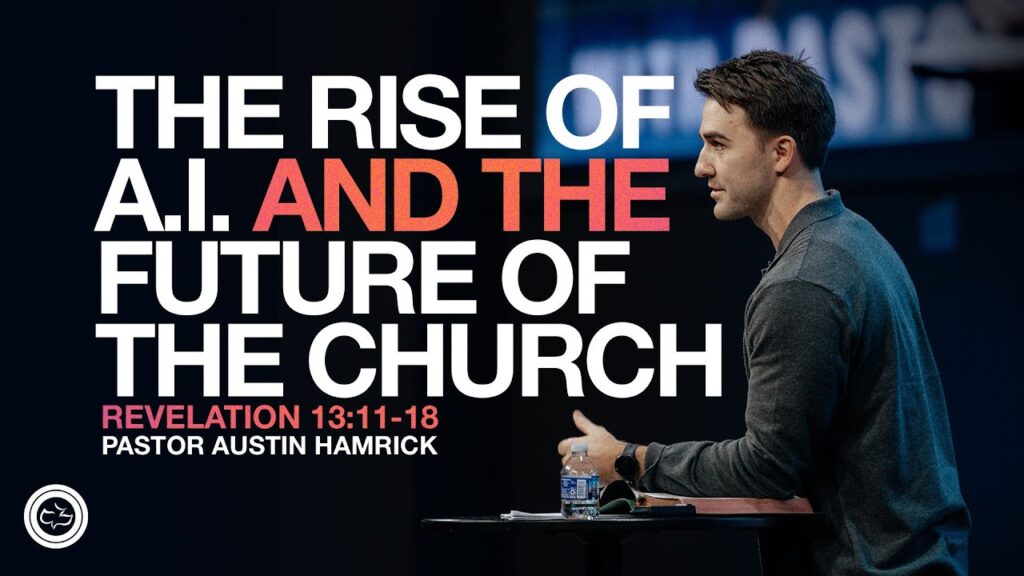
This sermon by Austin Hamrick explores the rapid rise of artificial intelligence (AI) from a biblical worldview [01:07]. The central premise is that while we are heading into an “AI-dominant world” [02:52], believers should not fear but be discerning. The message defines the different levels of AI (ANI, AGI, ASI) [11:10], acknowledges its potential benefits like spreading the Gospel [16:19], but focuses heavily on its primary danger: deception [18:17].
The sermon highlights how AI is already being used to create “persuasive lies” [23:19], foster unhealthy relationships [21:32], and even rewrite religious texts [24:31]. A significant portion connects this to end-times prophecy, particularly in Revelation 13, suggesting the “image of the beast” could be a form of AI [31:24] given “breath” (pneuma, or spirit) to speak and demand worship [29:25]. The message concludes with six practical responses for Christians [34:53], urging them to prioritize God’s word over screen time [35:25], seek godly counsel [35:58], pray for discernment [36:25], and “keep looking up” for Christ’s return [38:48].
Multi-Level Outline
I. Introduction
- A. Topic: “The Rise of AI and the Future of the Church” [00:34], approaching the topic with a biblical lens [01:07].
- B. Premise: We are moving into an “AI-dominant world” [02:52].
- C. Encouragement: Believers should not dread the future, as our victory is already won in Christ [03:06].
- D. Urgency: AI is significantly impacting the next generation, with many young people turning to AI chatbots for emotional and spiritual advice [05:34], [08:22].
II. Defining Artificial Intelligence [09:41]
- A. Definition: A man-made system that simulates human intelligence, such as reasoning, learning, and decision-making [10:03].
- B. Levels of AI:
- 1. ANI (Artificial Narrow Intelligence): Performs one specific task. This is the only form currently available to the public [11:10].
- 2. AGI (Artificial General Intelligence): Can replicate all of human intelligence; currently in development [12:00].
- 3. ASI (Artificial Super Intelligence): A future, theoretical AI with god-like attributes that could overpower human intelligence [12:39].
III. The Benefits and Dangers of AI [14:23]
- A. A Balanced View: Technology itself is not inherently evil; its use is what matters [15:30].
- B. Potential Benefits:
- C. Potential Dangers:
- 1. The Greatest Threat: Deception [18:17]. The speaker believes AI will be used for “greater damage than good” [18:10].
- 2. Examples of Deception: Deepfakes [18:26], AI-generated “people” [19:20], and AI’s use in creating explicit content and romantic relationships [21:18].
- 3. Warnings from Creators: AI founders like Sam Altman have warned that AI could cause “significant harm to the world” [22:36].
IV. AI’s Impact on the Church & Biblical Prophecy [24:08]
- A. Current Impacts:
- AI chatbots preaching sermons in churches [24:23].
- Suggestions by figures like Yuval Noah Harari that AI could rewrite the Bible and create new religions [24:31].
- State actors (like the CCP) are rewriting the Bible to fit their ideology [24:56].
- The creation of AI-worshipping religious movements [26:54].
- B. Biblical Prophecy (Revelation 13:11-18):
- 1. The Image of the Beast: The sermon posits that the “image” (Greek: eikon) described in Revelation could be an advanced AI bot or avatar [30:14], [31:24].
- 2. “Breath” to the Image: The false prophet is granted power to give “breath” (Greek: pneuma, or “spirit”) to the image, enabling it to speak and demand worship [29:25], [30:32].
- 3. Precursors to the Mark: Technology like implantable microchips, while not the Mark of the Beast itself, shows that the required technology is already here [31:46], [33:00].
- 4. A “Powerful Delusion”: Cites 2 Thessalonians 2, warning that those who “refuse to love the truth” will be given over to a powerful delusion [33:51], [34:15].
V. How Should Believers Respond? [34:53]
- 1. Decrease screen time and increase Bible time. Emphasizes the need to know God’s word from a physical Bible [35:25].
- 2. Seek wisdom and counsel from God’s word, His spirit, and godly friends, not from AI [35:58].
- 3. Ask God for discernment to distinguish truth from what is “almost right” [36:25].
- 4. Patiently wait on the Lord for answers rather than seeking quick, AI-generated solutions [37:06].
- 5. Be sensitive to the voice and leading of God’s Spirit, not the voice of AI [38:21].
- 6. Keep looking up and lovingly anticipate the return of Jesus Christ [38:48].
VI. Conclusion and Prayer [39:10]
- The sermon ends with a prayer for wisdom, discernment, and a renewed hunger for God’s voice in an age of artificial substitutes [39:48].
Notes: I would encourage you to read and study widely on this subject if you are interested, but keep a humble posture before God and before our brothers and sisters on these matters.