
Wretched man that I am! Who will deliver me from this body of death? Thanks be to God through Jesus Christ our Lord! So then, I myself serve the law of God with my mind, but with my flesh I serve the law of sin. Therefore, there is now no condemnation for those who are in Christ Jesus… For what the law was powerless to do because it was weakened by the flesh, God did by sending his own Son in the likeness of sinful flesh to be a sin offering. And so he condemned sin in the flesh, in order that the righteous requirement of the law might be fully met in us, who do not live according to the flesh but according to the Spirit… Therefore, brothers and sisters, we have an obligation—but it is not to the flesh, to live according to it. For if you live according to the flesh, you will die; but if by the Spirit you put to death the misdeeds of the body, you will live. For those who are led by the Spirit of God are the children of God.
Romans 7:24-8:1, 3-4, 12-14 (NIV)
In preparation to preach the Romans 8 series, I found this interesting snippet from R.C. Sproul’s “The Power of the Gospel: A Year in Romans”:
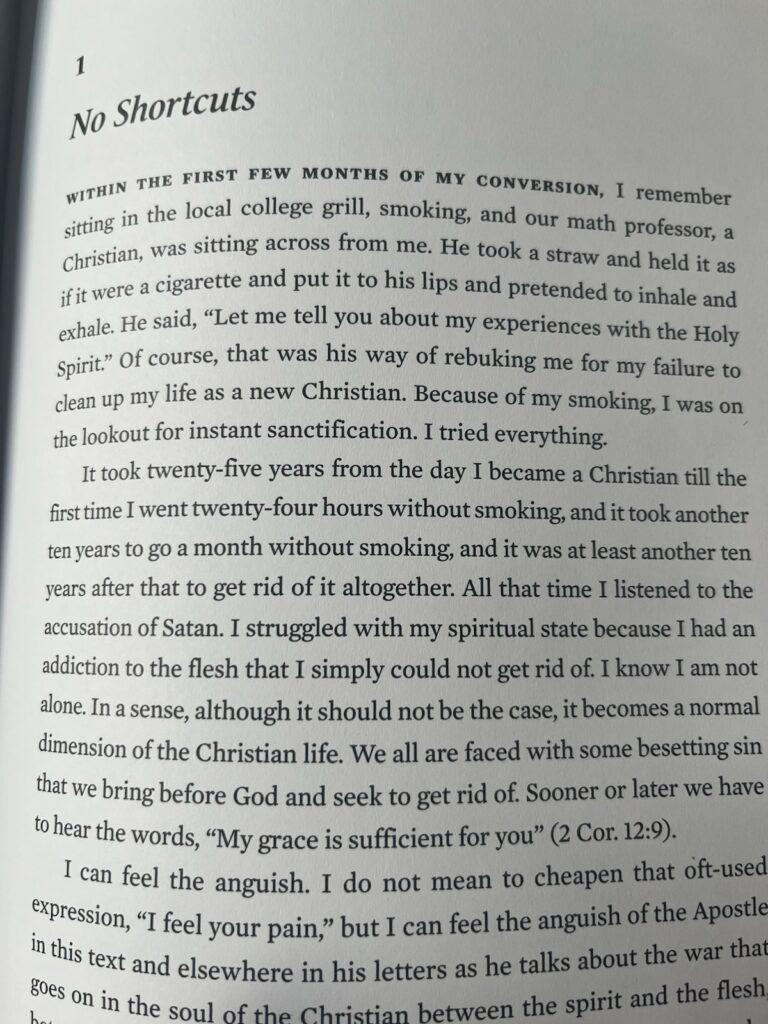
This begs the question, “How could a Christian smoke for 45 years after his conversion and honestly be a well-known Reformed theologian and respected seminary professor?”
This question hits hard, doesn’t it? It challenges our assumptions about what the Christian life, especially for a leader, is supposed to look like. It forces us to grapple with the messy reality of ongoing struggle this side of glory. To answer it honestly, we need to anchor ourselves in some fundamental truths of the very gospel Sproul himself championed.
First Things First: Saved by Grace, Not Perfection
Before we go any further, let’s be crystal clear: our standing before God does not depend on our performance, our ability to conquer habits, or our level of achieved sanctification. A Christian is someone who, by grace through faith in Jesus Christ, has been forgiven, declared righteous (justified), adopted into God’s family, and given the indwelling Holy Spirit (Romans 3:22-24, 5:1, 8:9). It is a gift received, not a status earned. Our identity is secured by Christ’s finished work and the Spirit’s seal (Ephesians 1:13-14), not by our ability to immediately “clean up our lives,” as Sproul’s professor perhaps insensitively put it. Sproul, despite his struggle, could be a genuine Christian and theologian precisely because his salvation, like ours, rested entirely on God’s grace in Christ, not on his success in quitting smoking.
The Reality: Life “According to the Spirit” Means War, Not Instant Victory
Being saved by grace and indwelt by the Spirit (Romans 8:9) instantly changes our position and identity. But it doesn’t instantly eradicate our sinful nature or the ingrained patterns of the “flesh.” Instead, it inaugurates a lifelong process called sanctification – learning to live out our new identity. This is exactly what Paul describes in Romans 8:5-13. It’s a call to “set [our] minds on the things of the Spirit” (v. 5) and, crucially, “by the Spirit put to death the deeds of the body” (v. 13).
Notice the dynamics: It’s a process (“set your minds,” “put to death” – ongoing actions). It requires our participation (“you put to death”). And it’s accomplished by the Spirit’s power (“by the Spirit”). Sproul’s title, “No Shortcuts,” perfectly captures this. His 45-year battle wasn’t evidence against his faith; it was a raw, painful demonstration of the slow, often agonizing reality of progressive sanctification – the “war that goes on in the soul of the Christian between the spirit and the flesh,” as he put it. This struggle is normal, though not desirable, in the Christian life.
Nuancing Sin: Is Smoking a “Blood” Issue?
Now, we need to think carefully about the nature of the struggle. Is smoking, in itself, a sin on par with denying Christ or committing adultery? Here, Keith Drury’s framework of “Pencil, Ink, and Blood” is incredibly helpful.
- Blood issues: Core doctrines essential for salvation (e.g., the deity of Christ, salvation by grace). Non-negotiable.
- Ink issues: Important theological distinctives that define denominations or traditions, worth writing down and defending, but not usually salvation issues (e.g., mode of baptism, specific views on eschatology).
- Pencil issues: Matters of opinion, culture, or personal conscience where Scripture gives no direct command (adiaphora). These can be discussed and even changed.
Where does smoking fit? For most, it’s clearly a “Pencil” issue. There’s no Bible verse saying, “Thou shalt not smoke tobacco.” It’s not a “Blood” issue determining salvation, nor is it typically an “Ink” issue defining major theological boundaries (though some specific church cultures might treat it as such).
But “Pencil” Issues Can Still Become Sinful
Here’s the crucial nuance: Just because something is a “Pencil” issue doesn’t mean it can never be sinful for a particular person in a particular context. How?
- Enslavement (1 Cor 6:12): Paul says, “‘All things are lawful for me,’ but I will not be dominated by anything.” When a “pencil” issue becomes an addiction, as Sproul honestly admitted his smoking was (“an addiction to the flesh that I simply could not get rid of”), it violates this principle. We become enslaved to something other than Christ.
- Stewardship & God’s Glory (1 Cor 6:19-20, 10:31): Our bodies are temples of the Holy Spirit. Habits known to harm the body raise serious questions about stewardship. Can we knowingly harm God’s temple and claim we are doing it “to the glory of God”? Addiction complicates this immensely.
- Conscience (Rom 14:23b): “For whatever does not proceed from faith is sin.” If your conscience is troubled by a “pencil” activity, continuing in it despite that conviction is sin for you. Sproul’s desire to quit suggests a troubled conscience.
- Known Good (James 4:17): “So whoever knows the right thing to do and fails to do it, for him it is sin.” If we know a certain action (like pursuing freedom from addiction) is the right path for us, but we fail to pursue it actively (even if the struggle is hard), we fall short.
- Love for Others (Rom 14:15, 21; 1 Cor 8:9-13): This is the principle of Christian liberty. Even if something is permissible for us (“pencil”), we are called to limit our freedom if exercising it causes a “weaker brother” (one with a sensitive conscience on the matter) to stumble or violate their own conscience. Remember Drury’s father driving 100 miles to visit an amusement park – an activity deemed worldly by some in his church. He restricted his freedom out of love.
So, Sproul’s smoking, while starting as a “pencil” issue, likely became sinful for him primarily due to enslavement/addiction and the related stewardship/conscience issues.
The Tightrope Walk: Discretion vs. Hypocrisy
This brings us to the outward appearance. How could he function as a leader? Wouldn’t hiding it be hypocritical? We must distinguish between discretion and hypocrisy.
- Hypocrisy is wearing a mask – deliberately presenting a false image of righteousness or victory to deceive others, often while condemning them for the same things you secretly practice. It’s rooted in pride and deceit.
- Discretion, however, can be motivated by wisdom, privacy, or even love. It might involve not flaunting a “pencil” freedom that could stumble others (like Drury’s dad). It might involve keeping a deep, personal, perhaps shameful struggle private while battling it, not out of deceptive pride, but out of pain or a desire not to cause unnecessary offense.
For someone like Sproul, managing his addiction likely involved significant discretion. Was there a danger of it tipping into hypocrisy? Yes, if he had actively projected an image of having conquered all such fleshly weaknesses or harshly judged others. But simply not publicizing a deep-seated struggle isn’t automatically hypocrisy. His eventual honesty in writing, like in the passage shared, speaks volumes against a charge of ultimate hypocrisy. It demonstrates vulnerability and a desire to use his struggle to teach the truth about grace and sanctification.
Answering the Question: Embracing the Principle
So, how could R.C. Sproul smoke for 45 years and be a genuine, respected Christian leader?
- Because salvation is by God’s grace through faith alone, not by works or habit-breaking.
- Because sanctification is a lifelong process, often slow and arduous, involving war against the flesh empowered by the Spirit (“No Shortcuts”).
- Because his specific struggle, while becoming sinful for him due to addiction, was rooted in a “pencil” issue, not a denial of core faith.
- Because navigating such struggles often involves discretion, which, while needing careful self-examination, is not the same as hypocritical deception, especially when followed by honesty.
- Because ultimately, God’s grace was sufficient for him (2 Cor 12:9), sustaining him in faith even amidst profound struggle.
How Does This Help Us?
Sproul’s story, viewed through the lens of Scripture, gives us principles for interacting within our own church community:
- Extend Grace: Remember that everyone you meet is saved by grace and engaged in their own unseen battles. Don’t judge salvation based on outward struggles.
- Be Patient: Recognize that sanctification is a process. Offer support and encouragement, not condemnation, especially regarding long-term struggles.
- Distinguish Issues: Don’t elevate “pencil” issues to the level of “blood” issues. Avoid legalism and majoring on minors.
- Exercise Liberty Lovingly: Be mindful of how your freedom in “pencil” areas might affect others. Prioritize love and edification over personal rights.
- Discern Discretion from Hypocrisy: Be slow to accuse someone of hypocrisy. Allow for privacy and discretion, while encouraging authenticity and seeking help when needed. Pray for wisdom and humility in your own life.
R.C. Sproul’s struggle doesn’t excuse sin, but it powerfully illustrates the perseverance of God’s grace and the complex reality of living “Life in the Spirit” this side of heaven. It reminds us that our hope isn’t in our own strength or perfection, but in the Spirit who dwells within us, conforming us, however slowly, to the image of Christ.